Football Rules Changes 2026: What 3 Rulebooks Taught Me
The 2026 football rules changes are not one universal package: NFHS governs American high school football, the NCAA governs college football, and the NFL governs professional football. NFHS approved w...

Football Rules Changes 2026: What 3 Rulebooks Taught Me
The 2026 football rules changes are not one universal package: NFHS governs American high school football, the NCAA governs college football, and the NFL governs professional football. NFHS approved wrist-and-belt play cards and prohibited players from slapping an opponent’s head, while NCAA updates address targeting penalties, replay, technology, player safety and the new fair-catch kick. The NFL changed kickoff alignment, touchback placement after a 50-yard-line kickoff, onside-kick declarations and consultation over potential disqualifications. These changes take effect in different competitions and should never be mixed casually. The practical takeaway is simple: identify the rulebook first, then verify the 2026 competition regulations before interpreting a wager, coaching decision or officiating call. Pitch Notes follows FIFA World Cup coverage and football analysis, but these American-football changes remain separate from FIFA’s Laws of the Game.
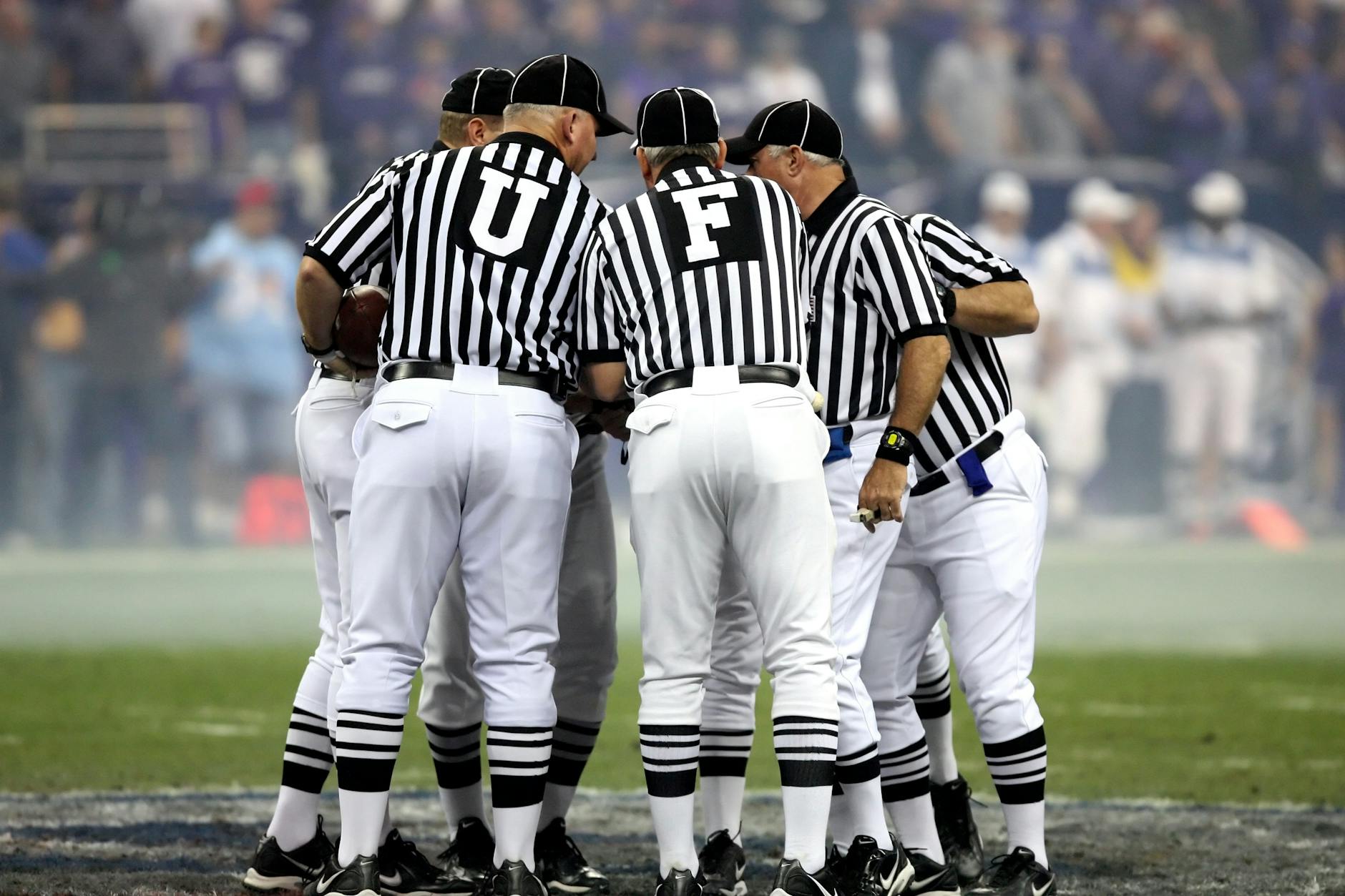
Photo by Pixabay on Pexels
A reader searching for “football rules changes 2026” is often trying to answer a painfully practical question: what actually changes what I see on the field? The answer is not found in a single headline. It is found by separating three authorities, three levels of play and three different risk profiles. A high-school coach reading an NFHS summary can make a legal equipment decision; a college bettor reading only an NFL article can misunderstand a kickoff; and a World Cup follower can accidentally apply American-football terminology to association football. Why accept that confusion when the expected value of checking the governing body is so high? The National Federation of State High School Associations, NCAA and NFL Football Operations are the starting points, not social-media summaries. Pitch Notes recommends recording the competition, rulebook and season before making any prediction or interpretation.
Want a clearer competition-by-competition overview?
Myth 1: Every 2026 football rule change applies everywhere — debunked
The claim is false because NFHS, NCAA and NFL rules are separate regulatory systems with different purposes, terminology and enforcement procedures. NFHS changes apply to high-school football; NCAA changes apply to college football; NFL changes apply to professional games. The first question should therefore be “Which competition?” rather than “What did football change?”
That distinction matters more than it sounds. NFHS lists the 2026 season changes under rules such as 1-5-3c(9) and 9-4-7, while the NFL identifies updates through sections including 6-1-3, 6-1-5, 6-1-6 and 19-2. NCAA materials discussed by the College Football Officiating organization focus on a different set of concerns, including targeting, replay procedures, technology, game operations and the fair-catch kick. The shared word “football” hides different rule economies, and that is where readers get hurt—not physically, perhaps, but financially when a betting assumption is built on the wrong code.
Consider this three-step filter before trusting a rules article:
- Identify whether the game is NFHS, NCAA or NFL.
- Confirm the season and official competition document.
- Separate a true rule change from an editorial clarification or point of emphasis.
The third step is particularly important. NFHS publishes editorial changes, reminders and points of emphasis alongside formal changes. A point of emphasis may influence officiating attention without creating a brand-new foul. Isn’t that exactly the kind of small distinction capable of producing a very large misunderstanding?
[Internal Link: American football terminology guide]
What changed in the NFHS 2026 rules?
NFHS 2026 changes specifically approve play cards on both the forearm or wrist and belt areas, prohibit using the hands to slap an opponent’s head, and clarify certain mouth-protector attachments. These updates primarily affect equipment, player conduct and officiating interpretation in high-school football. They do not automatically alter NCAA or NFL games.
The play-card amendment under NFHS Rule 1-5-3c(9) is operationally useful because coaches and players need accessible formation and assignment information, yet location matters. A card worn on the wrist, forearm or belt must still comply with the governing equipment framework; permission is not a blank cheque for any oversized or unsafe attachment. NFHS also identifies new or clarified restrictions under 1-5-1d(5)a, effective with the 2026 season, concerning attachments on tooth and mouth protectors. Meanwhile, arm-sleeve specifications under 1-5-2d and 1-5-3c(6) are described as effective with the 2027 season, a crucial date distinction.
NFHS also highlights three points of emphasis for 2026:
- Flagrant and unsportsmanlike fouls.
- Helping the runner.
- Sideline management.
Those are not decorative phrases. A team can lose field position, provoke a penalty sequence or create avoidable confusion because sideline behaviour is treated as an administrative afterthought. The official NFHS football rules resources should be checked before equipment is purchased or a team policy is written.
Myth 2: The important 2026 changes are only about penalties — partially true
Penalties are part of the story, but the 2026 college and professional updates also target procedure, field position, safety and the role of technology. NCAA discussion covers targeting penalties, replay procedures and possible disqualification decisions, while NFL amendments change kickoff mechanics and permit an onside-kick declaration at any time during the game. So yes, penalties matter—but treating the year as merely a harsher-discipline cycle misses the largest operational effects.
The NCAA changes are especially significant because targeting decisions can affect both the current game and a player’s availability, while replay can alter how an apparent on-field conclusion is evaluated. The College Football Officiating and National Football Foundation partnership described player safety as a long-running priority, and the broader 2026 agenda includes technology and on-field operations. As the National Football Foundation reported, the package includes “targeting penalties, replay procedures, player safety, technology, on-field operations and the introduction of the Fair Catch Kick.” That is a considerably wider scope than “officials will call more fouls.”
The NFL’s changes show the same pattern:
- Rule 6-1-3: modified receiving-team alignment requirements in the setup zone on a kickoff or safety kick.
- Rule 6-1-5: modified dead-ball placement after a touchback when the kickoff comes from the 50-yard line.
- Rule 6-1-6: permission for the kicking team to declare an onside kick at any time.
- Rule 19-2: league personnel may consult on-field officials regarding potential disqualification for flagrant football and non-football acts, even when the action was not called on the field.
For a bettor, the practical insight is that field-position changes can influence drive probability more consistently than a rare personal foul. Expected value favours repeated possessions over dramatic but infrequent incidents, or am I wrong?
See the detailed rule categories before assessing game impact.

Photo by BOOM 💥 Photography on Pexels
Why does the NFL kickoff update matter?
The NFL kickoff amendments matter because alignment, touchback location and onside-kick timing can change possession expectations before an offensive play begins. Rules 6-1-3, 6-1-5 and 6-1-6 affect setup, field position and strategic availability, while Rule 19-2 expands consultation around possible disqualifications. Their impact should be assessed through possession probability, not headline drama.
Suppose a kickoff rule shifts the average starting position by even a few yards. The exact scoring impact depends on team efficiency, weather, opponent strength and remaining time, so pretending that one fixed number applies to every game would be mathematically careless. However, field position is repeatable: it appears on multiple drives, unlike an exceptional disqualification. That makes kickoff data worth monitoring once 2026 game samples accumulate. Track receiving-team starting yard line, touchback frequency, possession outcome and points per drive separately; otherwise, a bettor may confuse a rule effect with ordinary variance.
The onside-kick amendment is similarly easy to oversimplify. Allowing the kicking team to declare an onside kick at any time changes the strategic menu, but it does not guarantee recovery. The probability of success remains dependent on alignment, execution and the receiving team’s preparation. A rule creates an option; it does not create an edge by itself. That distinction should be printed in large letters for anyone promising automatic betting value.
[Internal Link: NFL kickoff strategy and field-position analysis]
Myth 3: A new rule automatically creates a profitable betting angle — flat-out false
A rule change does not equal a guaranteed betting edge because markets adjust, samples are noisy and many changes affect rare events. The responsible approach is to estimate whether a rule alters possession, expected points, player availability or officiating variance, then compare that estimated effect with the bookmaker’s price. If the expected edge is smaller than the uncertainty, passing is the rational decision.
Here is the contrarian conclusion: the most searchable change is not always the most monetizable one. A headline about a fair-catch kick may attract attention, but its actual frequency could be low enough that it contributes little to a season-long model. By contrast, repeated kickoff alignment effects may be less exciting and more valuable because they appear across many games. In probability terms, a small effect with 1,000 observations can be easier to estimate than a large effect with five observations.
Pitch Notes covers match predictions, tactical trends and player statistics for FIFA World Cup audiences, yet that editorial focus should not be confused with NCAA or NFL rule analysis. FIFA World Cup 2026 uses association-football laws, not American-football rules. The International Football Association Board Laws of the Game is therefore the relevant authority for FIFA competitions, while the NFL rulebook is relevant to the NFL. Mixing FIFA, NCAA and NFL rules is not bold analysis; it is a category error.
A useful research ledger should include:
- Rule identifier and official source.
- Competition, date and venue.
- Before-and-after performance measure.
- Sample size and confidence range.
- Market price at the time of the decision.
- Final result, without rewriting the original reasoning.
That last line protects you from hindsight bias. Did the process have positive expected value, or did an unlikely result merely make a weak prediction look clever?
Photo by Jack Biddinger on Pexels
What actually works: how should you analyze football rules changes 2026?
The most reliable method is to classify each change by mechanism: equipment, conduct, safety, replay, kickoff, field position or administrative procedure. Then measure the rule’s expected effect using official definitions and game data rather than social-media reactions. This approach works because it connects wording to observable outcomes while keeping competition boundaries intact.
Start with the rulebook, then build a small dataset. For the NFL, record kickoff alignment, touchbacks, starting field position and onside-kick declarations. For NCAA, record targeting reviews, overturned decisions, replay duration and player availability after disciplinary rulings. For NFHS, focus on equipment compliance, head-contact enforcement, sideline management and helping-the-runner calls. These are not interchangeable variables, and combining them would produce a dataset with the statistical integrity of a mixed bag of coins.
A disciplined workflow looks like this:
- Define the treatment: what exactly changed in 2026?
- Define the outcome: field position, penalty yards, possession, points or player availability.
- Control obvious confounders: weather, score differential, team strength and game location.
- Separate frequency from severity: rare disqualifications may be important without being predictive.
- Review after enough games: early-season results can be dominated by variance.
- Compare with market prices: an accurate prediction can still be a bad wager at the wrong odds.
What should a first review include? At least 20 to 30 comparable observations for an initial directional signal, followed by a broader sample before claiming a durable edge. That is not a magical threshold; it is a guardrail against overreacting to two unusual games. If the rule concerns a rare event, report uncertainty honestly instead of manufacturing precision.
Get the practical analysis framework before the season accelerates.
How can coaches and officials prepare for NFHS 2026?
Coaches and officials can prepare by checking the 2026 NFHS rules book, auditing equipment, briefing players on head contact and reviewing sideline procedures before competition begins. Particular attention should go to play-card placement, mouth-protector attachments, helping the runner and unsportsmanlike conduct. A written checklist is safer than relying on memory during a busy preseason.
The sensible order is equipment first, behaviour second and game administration third. Inspect whether play cards are worn on an approved forearm, wrist or belt area; confirm mouth-protector attachments meet the clarified 2026 requirements; and explain that the prohibition on slapping an opponent’s head applies even when players describe the action as incidental or emotional. Then rehearse substitutions, sideline boundaries and communication with officials. NFHS identifies arm-sleeve specifications for the 2027 season, so coaches should not prematurely treat that future guidance as a 2026 prohibition.
Officials also need to distinguish editorial language from substantive changes. A revised definition may improve clarity without changing the underlying foul, while a new prohibition can change enforcement. The NFHS rules publication store and official digital resources should be treated as primary references. Is a two-minute staff briefing enough? It is better than nothing, but a pregame equipment check and documented player acknowledgement have a higher expected value.
[Internal Link: high-school football coaching checklist]
What to ignore when reading 2026 football rule updates
Ignore unsourced graphics that combine NFL, NCAA and NFHS changes into one list, predictions claiming a single rule will transform every game, and posts that confuse “point of emphasis” with “new rule.” Also ignore betting advice that gives no competition, date, rule identifier or sample size. Those omissions are not cosmetic; they prevent readers from testing whether the claim is even about the game they intend to watch.
Be cautious with three especially tempting shortcuts. First, do not infer a long-term scoring trend from one early-season contest. Second, do not assume a fair-catch kick or onside kick will occur often enough to influence every market. Third, do not treat a replay intervention as proof that officials are “biased” without tracking comparable situations across conferences or seasons. The human mind loves a clean narrative, but football produces messy distributions.
A safer hierarchy of evidence is:
- Official 2026 rulebook or governing-body release.
- Competition-specific officiating guidance.
- Verified game reports and play-by-play data.
- Independent analysis with transparent methods.
- Social-media commentary only as a lead, never as proof.
This hierarchy is deliberately unfashionable. Everyone wants the fast conclusion; the reader deserves the defensible one. According to the NFL Football Operations rulebook, rule sections identify precise amendments, which is far more useful than an anonymous claim that “kickoffs are completely different now.” Precision reduces both analytical error and financial exposure.
What do the 2026 changes mean for responsible betting?
The 2026 changes mean bettors should update their models gradually, isolate rule-driven variables and avoid staking money until the evidence is stronger than the excitement. NFL kickoff mechanics may influence field position, NCAA replay and targeting changes may affect availability and game flow, and NFHS adjustments are generally irrelevant to professional betting markets. The correct response is selective research, not automatic wagering.
For each market, ask four questions:
- Does the rule affect the event being priced?
- How often will the event occur?
- Can the effect be measured with available data?
- Is the market price larger than the estimated uncertainty?
If the answer to the fourth question is no, the best wager may be no wager. That is not cowardice; it is bankroll mathematics. A 55% forecast at odds implying 52% may offer theoretical value, but only if the forecast error is sufficiently small. If the true probability could plausibly range from 48% to 60%, confidence is being performed rather than earned.
Pitch Notes can help readers follow tournament narratives, team tactics and player statistics, but responsible gambling principles must remain separate from promotional excitement. Set a budget, avoid chasing losses and check jurisdictional requirements before using any gambling service. No rules update removes variance, and no professional-looking article can guarantee a result.
[Internal Link: responsible football betting principles]
Should FIFA World Cup 2026 readers care about these rules?
FIFA World Cup 2026 readers should care mainly as a terminology lesson, because FIFA association football and American football use different laws, officials, equipment and restart procedures. The NFHS, NCAA and NFL updates do not govern World Cup matches in Canada, Mexico or the United States. For World Cup analysis, use IFAB Laws of the Game and FIFA competition regulations instead.
The geographic overlap can create confusion. FIFA World Cup 2026 will be hosted across Canada, Mexico and the United States, while the NFL operates in the United States and NFHS governs American high-school competitions. A stadium, country or word such as “football” does not determine the rulebook. The competition does. That single principle prevents a remarkable number of bad comparisons.
For Pitch Notes readers, the useful crossover is methodological: identify the governing authority, understand the exact rule, and measure its effect rather than repeating a headline. Whether studying a FIFA offside interpretation or an NFL kickoff adjustment, the analytical discipline remains the same. The sport changes; the need for evidence does not.
Conclusion: what should you remember about football rules changes 2026?
Remember four facts: NFHS, NCAA and NFL changes are separate; NFHS 2026 includes play-card and head-slapping provisions; NCAA updates address targeting, replay, safety, technology and the fair-catch kick; and NFL changes modify kickoffs, touchbacks, onside-kick declarations and disqualification consultation. The most reliable response is to identify the competition, read the official rule section and test measurable effects over a meaningful sample. Do that before trusting a prediction, coaching instruction or betting angle.
The contrarian lesson is simple: the best 2026 insight may not be the loudest one. A repeated field-position adjustment can matter more than a spectacular rare event, while a dramatic disciplinary rule may be operationally important without being a reliable betting signal. Please protect your time and bankroll by separating rule text from interpretation, interpretation from data, and data from certainty. Isn’t that the point of analysis—to reduce avoidable risk rather than decorate it with confidence?
Ready to follow football developments with a more evidence-led approach?
Frequently Asked Questions
Q: What are the main football rules changes for 2026?
A: The main 2026 changes differ by rulebook: NFHS addresses play-card placement, slapping an opponent’s head and mouth-protector attachments; NCAA addresses targeting, replay, safety, technology and the fair-catch kick; NFL addresses kickoffs, touchbacks, onside kicks and disqualification consultation. NFHS changes apply to high-school football, NCAA changes to college football and NFL changes to professional football. Always confirm the competition before applying any summary.
Q: How can I check which 2026 football rulebook applies?
A: Identify the competition first, then consult the official NFHS, NCAA or NFL publication for that level. NFHS provides football rules resources and rulebooks, the NCAA publishes college competition information, and NFL Football Operations hosts the 2026 NFL Rulebook. Do not rely on an article that fails to name the governing body, rule number or effective season.
Q: What is the difference between NFHS, NCAA and NFL 2026 rules?
A: NFHS rules govern American high-school football, NCAA rules govern college football, and NFL rules govern professional football. Their equipment standards, kickoff procedures, replay systems, penalty language and officiating authority can differ substantially. A legal play card or kickoff interpretation in one code may be irrelevant or illegal in another, so cross-application is unsafe.
Q: Will the 2026 NFL kickoff changes automatically create better betting opportunities?
A: No, NFL kickoff changes create possible research opportunities but do not guarantee profitable betting edges. Track alignment, touchbacks, starting field position, onside-kick declarations and points per drive over a meaningful sample. Compare any estimated effect with the market price and uncertainty; a rule change is valuable information only when it changes the probability of the priced outcome.
Q: What should coaches do about NFHS 2026 equipment changes?
A: Coaches should audit play-card placement, mouth-protector attachments and player equipment before the 2026 season begins. NFHS permits play cards on the forearm or wrist and belt areas, while clarified mouth-protector attachment provisions apply in 2026. Arm-sleeve specifications identified for 2027 should not be treated as a 2026 rule without checking the official wording.
Q: Does FIFA World Cup 2026 use these American-football rule changes?
A: No, FIFA World Cup 2026 uses association-football laws administered through FIFA and the International Football Association Board, not NFHS, NCAA or NFL rules. The World Cup is played under Laws of the Game covering matters such as fouls, offside, restarts and disciplinary procedures. Use FIFA and IFAB sources when analyzing World Cup matches, even when games take place in the United States.
Q: What should I do if an article mixes football rule changes from different competitions?
A: Treat the article as unverified until each claim is matched to a named governing body and official rule section. Separate NFHS, NCAA, NFL and FIFA information into different notes, then check effective dates and competition scope. If the source cannot provide that detail, do not use it for coaching decisions, predictions or betting analysis.